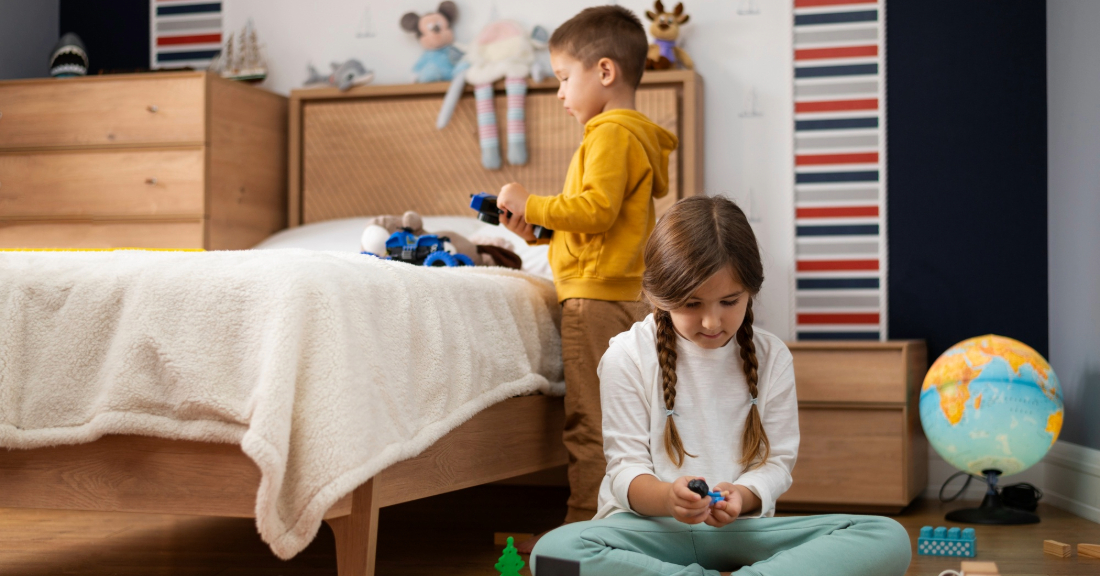
For a child, most aspects of their world are arranged for them, like the school they attend, the timetable, the rules of the house, and in many cases even the colour of the walls. However, if a bedroom is furnished with any intention, it is usually the only room in which a child has a real opportunity to make choices. For example, what is placed on the shelf, which side of the bed they consider their own, what is left out where they can see it and what is put away. Although this is only a small degree of control, for a child, small degrees of control are more important than adults generally remember.
At Shop R&R, we have seen that parents in Santa Barbara tend to think more about the furniture for their children than is generally given them credit for. It’s not merely a matter of choosing something durable that will last for a few years, even though that is important. What’s also at stake is allowing a child’s room to become their own in a manner that can keep up with the person the child is becoming.
Why a bedroom becomes a mirror of the self before a child can explain why
There is a well-established concept in the field of developmental psychology according to which children develop a sense of self in part through their environment, through the things they select, arrange, and return to. A bedroom is not merely a place where a child sleeps; it is one of the first canvases they are given to shape, in a world in which almost everything else has already been shaped for them. The stuffed animal that must stay exactly in that position. The drawing stuck up at precisely that angle. To an outsider, these things make no sense, and indeed it is unnecessary for them to. This is identity in its very first and most direct form, a child asserting that this is mine and that this is the way I want it.
That change isn't something that occurs suddenly; rather, it results from a series of small, accumulated choices over the years, choices that either support the process or simply get in the way of it. In a room which is too rigid, too prescriptive, and too obviously 'decorated' by another person, there is less room for this process to take place; whereas a room that has a certain degree of flexibility, furniture that can easily cope with a five-year-old's chaos as well as a fifteen-year-old's need for privacy supports it much better.
Santa Barbara childhoods move between more worlds than most
Growing up in this place usually involves developing multiple identities simultaneously: there's the side of beach mornings and then school uniforms, the calm of the mesa neighbourhoods alongside the buzz of downtown, a relaxed coastal lifestyle combined with very high expectations. Children often have to manage more different versions of themselves than they might in other places: that of the athlete, the student, and the one who still wants a nightlight even if they never admit it out loud. A bedroom that can accommodate all of these different aspects without forcing a child to decide on one too early ends up carrying out some quiet but significant work.
That is one of the reasons why a thematically designed room which is fixed to a particular time, although it may seem appealing at first, can begin to seem out of place after a couple of years. A bed frame with a dinosaur pattern will please a five-year-old but will only slightly embarrass an eleven-year-old. Furniture that is more oriented toward being flexible and well made, rather than following fashion, tends to last as long as the child rather than becoming outdated because of them.
What growth actually looks like in a child’s room
Parents never put it quite like this, but what they usually want is furniture that doesn't have to be completely replaced each time their child outgrows it. In reality, that desire usually arises as a request for:
● So that the bed frame remains suitable no matter how the room is decorated, whether it's decorated for dinosaurs this year or with band posters five years from now.
● Storage that can go from being used for toys to being suitable for schoolbooks to whatever a teenager needs to have hidden from sight, without requiring new furniture every time.
● A desk strong enough to withstand both crayon scribbles and later on real homework, without appearing to have been made for either of these extremes.
● A dresser with so much presence that it gives the room its stability, no matter how many times the walls surrounding it are repainted or the posters are changed.
● The furniture is well finished so that it can be transferred from a child's early room to a "big kid" room at a later stage without ever having to be replaced because of embarrassment.
These requests are not actually intended as a way of avoiding having to make a second shopping trip; rather, they are designed so that a child's identity can have room to change without the whole physical space having to change each time.
The quiet comfort of ownership, even in something small
Children have a certain kind of comfort coming from having a sense of ownership over their own space, even when the things they do seem insignificant to an adult. For example, picking where the stuffed animals should be placed, deciding which drawer contains what item, and moving the shelf about for the third time in a month with no reason that anyone else can see. Although these small acts of control appear to be of little importance, they actually matter a great deal because so much of a child's world runs without their involvement. A bedroom that enables this sort of small and continuous reordering gives a child a real feeling of having control over things, an experience which adults often do not realise is rare.
Furniture is more important in this situation than is usually given it credit. A room which has flexible storage and consists of simple, adaptable pieces encourages this kind of rearranging, while one in which all the elements are fixed and exactly matched in a single definite style tends to discourage it, even if that was never the intention. Children can tell, even if they cannot put it into words, whether a space was designed to allow their changes or to resist them.
Furniture that doesn’t flinch at real childhood
There is also merit in furniture that can cope with what real childhood is like. The things that aren't captured on paper, the jumping that isn't meant to take place on beds yet does anyway, and the many years of daily use that a piece described as delicate was never intended to endure. Furniture that is able to withstand such use ends up being more important to a child's feeling of security than most parents realise. A room doesn't seem safe and steady if the furniture in it looks breakable or precious; it only feels safe when the furniture can take in real life without breaking, which in a quiet way gives a child the assurance that this place, unlike so much of the rest of their world, is not fragile.
Durability goes beyond being merely practical; it is, in fact, a key factor in making a room seem as though it truly belongs to a child rather than having been borrowed and given to them with careful supervision. When furniture can sustain a knock and still appear perfectly fine the following morning, it gives children the right to actually live in their room rather than having to move about in a cautious manner.
A room that grows up without a child having to move out of it
One of the benefits of furniture selected in this way that is most often ignored is the amount of disruption it causes over time. A child's identity doesn't change according to a fixed timetable; instead, it changes in an irregular manner, speeding up in some years and remaining almost unchanged in others, so furniture which is only suitable for a very limited age range ends up forcing an artificial kind of transition that is hardly related to what the child really needs. On the other hand, furniture with a wider range, simpler lines, adaptable storage, and a finish that appears timeless rather than childish allows that shift in identity to take place naturally, within a room that doesn't have to be completely stripped out and restarted every few years.
It is more important than it at first appears that there should be continuity. A bedroom in which a child has spent most of their childhood, even though the posters and other interests in it have completely changed, acquires a kind of emotional significance different from that of a room which is entirely replaced every few years. It is a place with a history, not a place that has been decorated, so that a child can still see that it had belonged to him for a long time, although it has changed. It's been a long time, and they can recall most fondly the room itself, the familiar, familiar shape of the room, rather than any individual poster or bedspread; the room just was the room, and it was the same familiar shape, the same steady presence, which had been the same for so many years, while everything else changed, grew, evolved, developed.
Where this leaves you, if a child’s room feels like it’s outgrowing itself
If the bedroom of your child is beginning to look more like a picture of who they used to be than who they are at the moment, it may be a good idea to consider avoiding a complete overhaul and instead think about which of the items could actually grow with them. It doesn't mean that every element of the room has to be completely redesigned; sometimes all that's needed is a base that is flexible enough to accommodate whoever your child is going to become next.
The kids' furniture range offered by Shop R&R was designed with that kind of variety in mind, offering pieces which were sturdy enough for actual childhood and at the same time simple enough to age well with it. You can take a look at our kids'furniture collection here and let us help you to create a room that will grow up in Santa Barbara with your child.